Conservatives Want To Ban Pornography. It Saved My Life.
It’s potentially controversial to admit to it, but I think pornography might have saved my life.
I was 16 years old and a recent escapee from the Jehovah’s Witnesses, a conservative religious group with a long list of proscribed romantic and sexual activities (no gay sex, no pre-marital sex, no extra-marital sex, no oral sex, no dating before the age of 18, no divorce), when I discovered an unwelcome truth.
All my life, I’d had an enduring interest in the idea of being tied up, or maybe spanked. I gravitated toward stories in which people got captured or punished, reading the pages of those books over and over again until I’d memorized them, and wishing I could experience the same things.
It hadn’t occurred to me that this might be more than a strange personal thought experiment until I saw a depiction of self-flagellation in the movie “A Nun’s Story” and decided to try whipping myself with a belt. My reaction was sexual, rather than spiritual.
With no knowledge of how to frame any deviation from the sexual norm other than to label it as a sin, I assumed this discovery meant I was evil and that I should probably kill myself. Fortunately for me, the Jehovah’s Witnesses also had a lot to say about the sin of suicide, so I remained alive, guilt-wracked, attempting denial of who and what I was, and thoroughly unhappy.
This state of affairs lasted for nine years, and I spent the time paranoid that someone might sense my interest in this subject, and that I’d be rejected by everyone I cared about as a result. My secret felt like one which I must keep perfectly, forever, so I tried hard to appear normal — to be normal.
At 18, I began a relationship with a fellow student at drama school. Our romance didn’t progress as far as actual sex, but when he suddenly broke up with me after three months to date another girl in my year instead, I became convinced it was because he’d sensed that there was something terribly wrong with my sexual tastes. I determined to try harder — to never let anyone see what was wrong with me beneath the surface. Again, I considered suicide.
Being alone was painful, but risking being known was a far more frightening proposition.
The first portrayal I saw of someone who was maybe a bit like me was in “Pulp Fiction,” which I watched when I was 20. The rape scene, complete with BDSM paraphernalia and a gimp in a leather hood, was clearly intended to be horrific, and I was duly horrified. I wasn’t entirely alone in my interests, I concluded — there were perhaps some male rapists who were like me, though probably even they only existed in fiction. It was not a comforting thought.
When I was 24, the movie “Secretary,” starring James Spader and Maggie Gyllenhaal, was released. I took myself to see it at a cinema in Leicester Square. Alone, naturally. I couldn’t possibly have told any of my friends that I wanted to watch it. Even as it was, I was anxious that someone might recognize me.
I sat sheepishly in the dark, on the back row, and watched the gentle story of a young woman falling for her boss, who spanks her. She seems to like it. The problem was that in the first scene of the movie, she’s discharged from a mental institution, and she’s a habitual self-harmer. Her boss appears no less unstable. They weren’t rapists, which was something, but they weren’t OK, either.
I still didn’t consider the possibility that there might be people in the real world who liked this kind of thing, and that they might not have anything wrong with them at all. Until the following year, when I stumbled into an art gallery and found myself confronted by wall upon wall covered in BDSM artwork.
It was electrifying. I saw sculptures depicting submissive women, with no suggestion that they might be mentally unwell. I saw photographs of dominant men and women, with no implication that they might be murderers or rapists. For the first time in my life, I saw my sexuality represented without being pathologized. The relief of it still resounds in my mind, 21 years later.
Many of the artists whose work was displayed at the gallery were in attendance. One of them approached me, and asked if I’d like to model for him. I was already modeling professionally, so I agreed, and he introduced me to other members of the thriving BDSM art world.
Additionally, it was 2003, and the internet was booming with online magazines depicting all sorts of sexual tastes. I started contacting the photographers who worked on these magazines, asking for shoots.
For someone like me, who was confident working nude but ashamed of my sexual tastes, approaching the subject as a professional model felt safe. No one had to know that I had a personal interest in submission unless I chose to tell them.
In the beginning, I didn’t. But the people I found myself working with had no such inhibitions, and as I began to make friends within my new world, their lack of shame began to erode my own. My shame wore away a little more each time that I appeared online in pictures and videos, telling anyone who cared to look that “This is me. This is my sexuality.”
By the time I’d been modeling in the BDSM field for a year, I’d started to admit to being kinky when I was at work. Having discovered that there were a lot of people like me, I stopped pretending to be vanilla to my non-work friends, either. I was proud of the artwork I was creating, and keeping it a secret began to feel unnecessary.
I realized that by producing this work, I could let people like the person I’d once been know that their kinks were OK, too. They could see my photographs, and they’d know they weren’t alone.
I wished I could send some of them back in time to my 18-year-old self, to show her that there was nothing wrong with her after all.

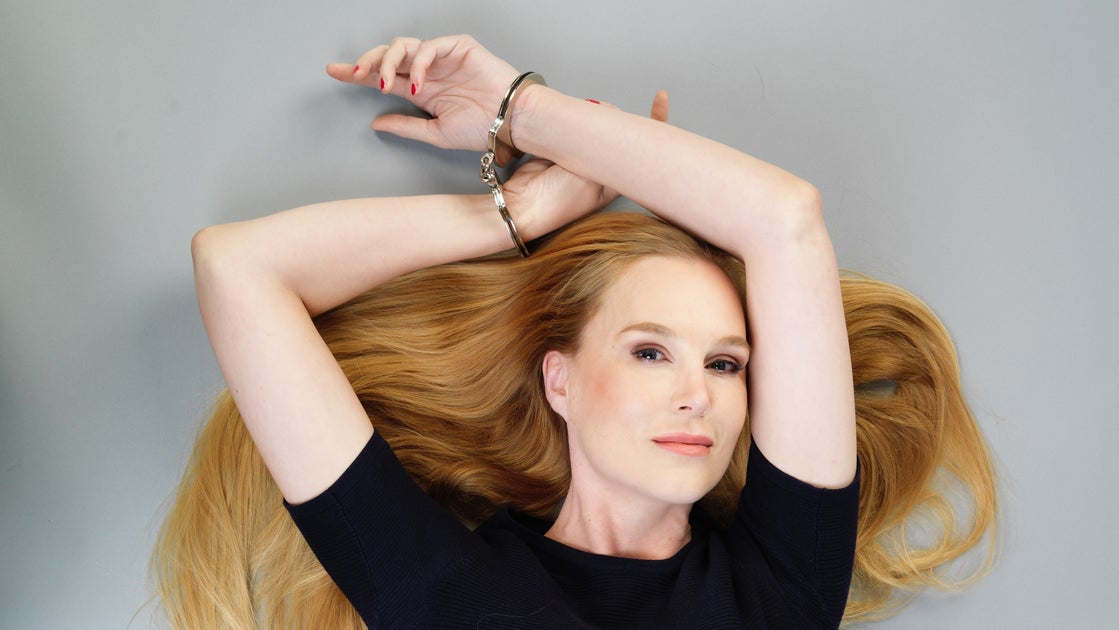
Photo Courtesy Of Ariel Anderssen
Twenty-one years later, this is still what I do. My career has been remarkably good to me. I met my husband (an ex-CERN particle physicist who’d given up his lectureship at the University of London to become a bondage photographer) at a photoshoot, and that’s how I made most of my friends too. I’m financially stable in a way I never expected to be, and I’ve been able to provide for my family. I produce work that I’m proud of, and the fact that its intention is to arouse people does not make me uncomfortable. Orgasms are good for us, and I’m happy to help.
So the increasing consolidation of executive power behind right-wing policies like those outlined in the Heritage Foundation’s Project 2025, surprises me in the assumption that porn is inarguably bad for us and should be banned.
“We’d have a national ban on pornography if we could, right?” commented Russell Vought, one of the architects of Project 2025, and founder of the right-wing think tank, the Center for Renewing America, caught on a hidden-camera recording. As though the majority of American adults weren’t viewing pornography of some sort on a regular basis.
The U.K. government, with concerns similar to those of the U.S.’ leadership, has recently passed the Online Safety Act into law, which requires adults to upload photographic ID in order to access sites that feature any content inappropriate for under 18.

It sounds like a perfectly reasonable proposition at first. I don’t want children to watch porn, just as I don’t want them to watch R-rated movies, or drink alcohol or drive cars. But I can’t help but consider the potential for catastrophic data leakage, with people’s private sexual tastes being linked to their photos, and then broadcast to the rest of the world.
Once, shame about my sexuality made me suicidal. As a result of my work, I’ve developed a degree of comfort regarding my sexual tastes being public knowledge, but most of us do not enjoy that luxury.
This attempt to stop children viewing pornography is also clearly part of a conservative groundswell aimed at inhibiting the adult audience for whom the content was intended, and for whom it is sometimes enormously valuable.
Yes, there probably are many people for whom pornography has not been a positive influence ― people who have developed an unhealthy dependence on it, were exposed to it at an inappropriate age, or whose partners prefer porn-accompanied masturbation to a shared sex life.
But I wonder, how many more people are there like me, for whom porn was the first art form that comforted them, informed them their sexual tastes were legitimate, and showed them that they weren’t alone? I’ve certainly met hundreds of those people, and communicated with thousands.
Any war on pornography will almost inevitably affect the smallest, niche producers first and worst, since they have the fewest resources to fight back, and this troubles me because I think they’re often the ones who are doing the most good, in terms of representing a wide range of sexual identities, activities and body types without judgment.
If seeing my sexuality represented was a powerful comfort for me, how much more valuable might it be for someone with a marginalized identity? For a queer person living in a small town, or a person with a disability, seeing people like themselves represented as desirable could be transformative.
Pornography has been ahead of mainstream media in reflecting the fact that LGBTQ+ people exist, have sex lives that matter, and deserve to be visible, all wins that the right wing would love to see undone.
For me, pornography did what no sociology textbook could do. It told me that I was OK, and gave me hope I might one day find a partner who’d think my tastes were OK, too. It followed that one day I might be able to have a sex life in which I could be honest about my desires after all.
The knowledge of these things helped me believe I deserved to be alive. I fear that a world without pornography could be a world in which so many people like me never get there.
Ariel Anderssen is a classically trained actress and submissive BDSM model, filmmaker and writer based in the U.K. Her memoir “Playing To Lose” is available on Amazon. You can find her on Twitter at @ArielAnderssen. Her website is www.arielanderssenauthor.com, her Substack is www.substack.com/@arielanderssen and she replies to all (sensible) emails.
Do you have a compelling personal story you’d like to see published on HuffPost? Find out what we’re looking for here and send us a pitch at [email protected].